
NECO Result Grading System: Everything You Need To Know
If you’re searching for clear information about NECO, especially how the grading system works, you’re in the right place. The National Examinations Council uses a specific grading format that includes scores like A1, B2, C6, and F9, and each of these grades has a direct impact on your academic progress.
Understanding NECO grades is important if you want to know whether you passed, qualified for admission, or need to improve in certain subjects. In this i explained everything you need to know about Neco and system grading.
What Is NECO
The National Examinations Council (NECO) is a Nigerian government examination body responsible for conducting and managing secondary school exams.
It was established in 1999 to provide an alternative to other exam bodies like WAEC. NECO conducts exams for students in their final year of secondary school and also offers other certificate exams.
Key Facts About NECO:
- It is fully owned by the Nigerian government
- It conducts exams within Nigeria
- Results are widely accepted for admission into universities and colleges
- It is known for affordability compared to other exam bodies
Why NECO Is Important In Nigeria
NECO plays a major role in the Nigerian education system. Without passing NECO or a similar exam, it is difficult to gain admission into higher institutions.
Here’s why NECO matters:
- It serves as a final secondary school assessment
- It is required for university and polytechnic admission
- It provides proof of academic qualification
- It helps students move forward in their careers
In simple terms, NECO is one of the main stepping stones to your future.
Types Of NECO Exams
NECO conducts different exams depending on the category of candidates.
SSCE Internal (June/July)
This is for students in secondary schools.
- Written by SS3 students
- Conducted in schools
- Most common NECO exam
SSCE External (GCE – Nov/Dec)
This is for private candidates.
- For people not in school
- Flexible registration
- Suitable for retaking subjects
BECE (Basic Education Certificate Examination)
- For junior secondary school students
- Helps students move to senior secondary level
NECO Registration Process (Step-by-Step)
If you’re planning to register for NECO, here’s a simple guide:
Confirm Eligibility
Make sure you are:
- In SS3 (for internal exam), OR
- A private candidate (for external exam)
Visit An Approved Center
Registration is usually done:
- Through your school (internal)
- At accredited cyber cafés or centers (external)
Provide Your Details
You will need:
- Full name
- Passport photograph
- Date of birth
- Subject selection
Pay Registration Fee
- Fees vary each year but are generally affordable compared to alternatives.
Capture Biometrics
- Fingerprint and photo capture are required to prevent malpractice.
Collect Your Exam Slip
This contains your:
- Exam number
- Subjects
- Exam schedule
NECO Timetable And Exam Structure
NECO exams are structured to test students across different subjects.
Subjects Include:
- English Language
- Mathematics
- Sciences (Biology, Chemistry, Physics)
- Arts and Commercial subjects
Exam Format:
- Objective questions (multiple choice)
- Theory questions
- Practical exams (for science students)
Timetables are usually released months before the exam, so students have time to prepare.
How To Check NECO Result (Easy Guide)
One of the most common reasons people search for NECO is to check results.
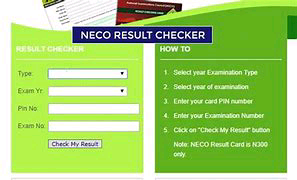
Steps to Check Your Result:
- Go to the official NECO result checking portal
- Enter your exam number
- Select your exam year
- Enter your token or scratch card PIN
- Click “Check Result”
Your result will appear instantly if everything is correct.
NECO Result Grading System
NECO uses a grading system similar to other exam bodies:
| Grade | Meaning |
|---|---|
| A1 | Excellent |
| B2 | Very Good |
| B3 | Good |
| C4–C6 | Credit |
| D7 | Pass |
| E8 | Weak Pass |
| F9 | Fail |
What You Need for Admission:
Most universities require:
- At least 5 credits, including English and Mathematics
NECO vs WAEC: Which Is Better?
Many students compare NECO with WAEC before choosing.
NECO Advantages:
- More affordable
- Questions often straightforward
- Focused on Nigerian curriculum
WAEC Advantages:
- International recognition
- Wider acceptance outside Nigeria
Note: Both are accepted in Nigeria. Choose based on your needs.
Common Challenges Students Face With NECO
Even though NECO is helpful, students sometimes face issues:
Late Registration
- Missing deadlines can prevent you from writing the exam.
Exam Malpractice Risks
- Strict penalties exist for cheating.
Result Delays
- Results may sometimes take time to be released.
Incorrect Details
- Errors during registration can affect results.
- Always double-check your information before submitting.
Tips To Pass NECO Successfully
Passing NECO is possible with the right approach.
Study Smart:
- Follow the syllabus
- Practice past questions
Stay Consistent:
- Study daily instead of cramming
Attend Classes:
- Pay attention to teachers
Avoid Malpractice:
- Focus on preparation instead of shortcuts
Use Reliable Materials:
- Read recommended textbooks
Frequently Asked Questions – (FAQs)
Is NECO Result Accepted In Universities?
Yes, NECO results are accepted by universities, polytechnics, and colleges in Nigeria.
How Long Does NECO Result Take?
Results are usually released within a few months after the exam.
Can I Combine NECO With WAEC?
Yes, many institutions allow combining results.
How Much Is NECO Registration?
Fees change yearly, so always check the latest update from official sources.
Can I Rewrite NECO?
Yes, through the NECO GCE (external exam).
Safety Tips And Important Warnings
To protect yourself:
- Only register through approved centers
- Avoid buying fake result upgrades
- Do not share your result token publicly
- Keep your exam number safe