Rivers State University (RSU) 2026: Cut-Off Mark, Courses, School Fees & Everything You Need To Know
Port Harcourt is oil country, and Rivers State University was built to match. With one of the strongest engineering pedigrees among Nigerian state universities — born out of a technology institute — RSU has long been the go-to choice for South-South students chasing engineering, technology, and the sciences, with medicine and law now firmly in the mix too. In a city powered by industry, RSU produces the people who keep it running.
This guide gives 2026 applicants the full breakdown: the cut-off mark, departmental scores, the complete course list, a clear fee table, and the road from JAMB to resumption.
RSU: The Backstory
Rivers State University, widely known as RSU, is owned by the Rivers State Government and located in Nkpolu-Oroworukwo, Port Harcourt. Its history is part of its identity: it began in 1979 as the Rivers State University of Science and Technology (RSUST), a technology-focused institution, before being restructured and renamed Rivers State University in 2017 to operate as a full conventional university.
That technology DNA still defines the school. RSU is widely respected for Engineering, Environmental Technology, and the applied sciences — a natural fit for a city at the heart of Nigeria’s oil and gas industry. Over the years it has broadened into a comprehensive university with a College of Medical Sciences, a Faculty of Law, Management Sciences, Social Sciences, Education, Agriculture, and the Humanities.
The Port Harcourt location is both an asset and a consideration — strong industry links and internship opportunities, but a higher cost of living than smaller university towns. For regional comparison, our UNIPORT cut-off guide covers RSU’s federal neighbour in the same city, and the UNIOSUN cut-off calculation guide explains the aggregate scoring state universities like RSU rely on.
RSU’s 2026 Cut-Off Mark
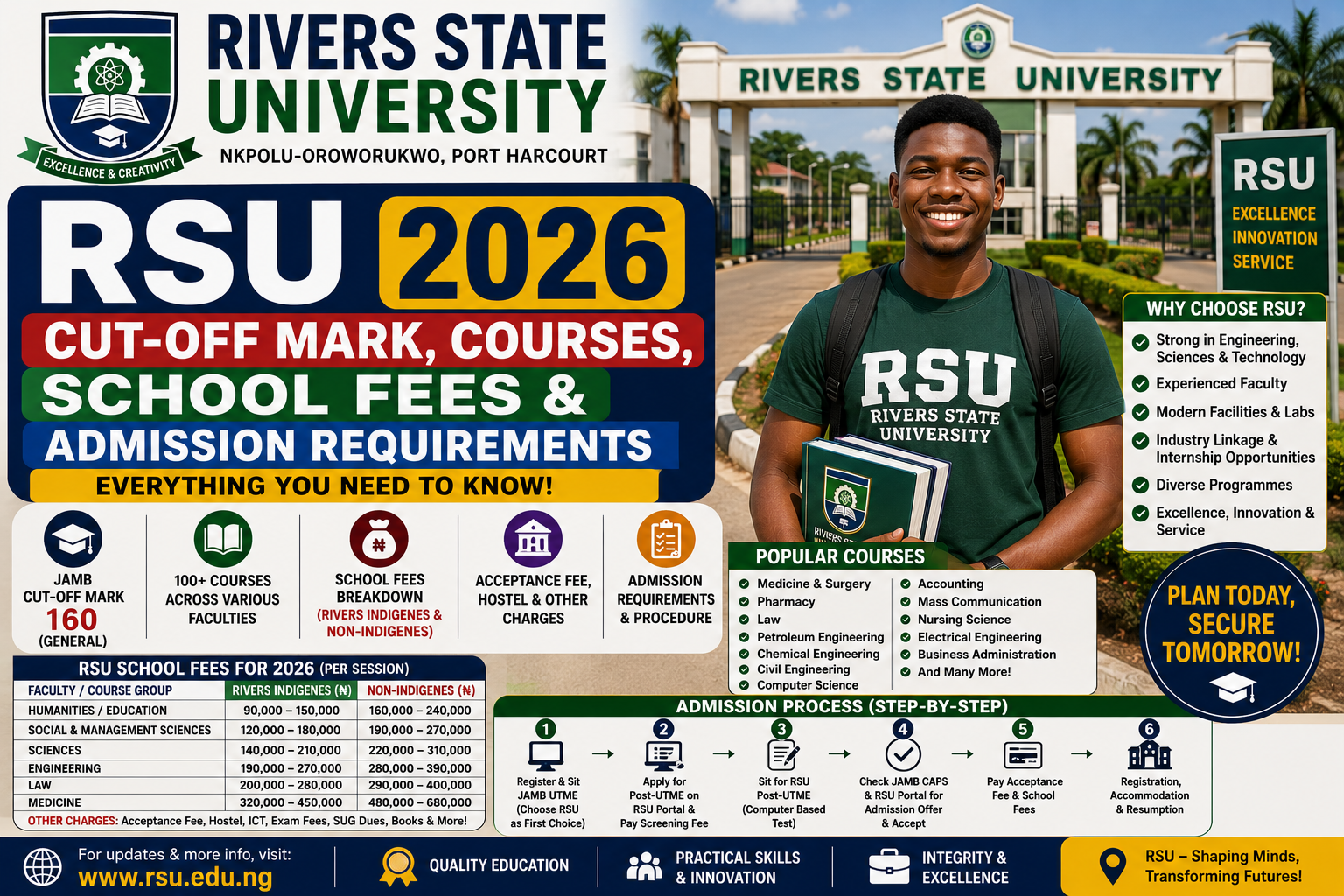
RSU set its general UTME cut-off at 160 for the 2026/2027 session — above the national minimum of 150 confirmed at JAMB’s May 11, 2026 Policy Meeting. That elevated baseline fits a university with a competitive engineering and medical profile.
The usual reality check applies: 160 makes you eligible, but RSU’s marquee courses demand much more. Medicine sits around 270+, with Law, Pharmacy, and the top engineering disciplines not far behind. A 160 works for many education, agriculture, and humanities courses — but treat it as the floor, not your target, if you’re aiming high.
RSU Departmental Cut-Off Marks For 2026 (Estimated)
The scores below indicate typical competitiveness per programme. They’re estimates from past trends and can move with each year’s applicant pool.
| Course/Department | Estimated JAMB Cut-Off | Aggregate Needed |
|---|---|---|
| Medicine and Surgery (MBBS) | 270 – 300 | 72+ |
| Pharmacy | 250 – 280 | 68+ |
| Nursing Science | 250 – 280 | 68+ |
| Medical Laboratory Science | 230 – 260 | 64+ |
| Physiotherapy | 220 – 250 | 62+ |
| Dental Technology | 200 – 230 | 59+ |
| Anatomy | 200 – 230 | 58+ |
| Physiology | 200 – 230 | 58+ |
| Law (LLB) | 250 – 280 | 67+ |
| Petroleum Engineering | 230 – 260 | 65+ |
| Chemical/Petrochemical Engineering | 220 – 250 | 63+ |
| Civil Engineering | 215 – 245 | 62+ |
| Mechanical Engineering | 210 – 240 | 61+ |
| Electrical/Electronic Engineering | 215 – 245 | 62+ |
| Computer Engineering | 215 – 245 | 62+ |
| Marine Engineering | 210 – 240 | 61+ |
| Agricultural Engineering | 190 – 215 | 56+ |
| Computer Science | 215 – 245 | 62+ |
| Information Technology | 195 – 220 | 57+ |
| Accounting | 205 – 235 | 60+ |
| Banking and Finance | 190 – 215 | 56+ |
| Business Administration | 190 – 215 | 56+ |
| Economics | 195 – 220 | 57+ |
| Mass Communication | 215 – 245 | 62+ |
| Political Science | 185 – 210 | 54+ |
| Sociology | 175 – 200 | 52+ |
| Psychology | 185 – 210 | 54+ |
| English Studies | 180 – 205 | 53+ |
| History and Diplomatic Studies | 165 – 190 | 50+ |
| Microbiology | 200 – 230 | 58+ |
| Biochemistry | 200 – 230 | 58+ |
| Chemistry | 180 – 205 | 53+ |
| Physics | 180 – 205 | 53+ |
| Mathematics | 170 – 195 | 51+ |
| Geology | 185 – 210 | 54+ |
| Architecture | 205 – 235 | 60+ |
| Estate Management | 180 – 205 | 53+ |
| Surveying and Geoinformatics | 180 – 205 | 53+ |
| Urban and Regional Planning | 170 – 195 | 51+ |
| Agriculture | 160 – 185 | 50+ |
| Education (various) | 160 – 190 | 50+ |
If your score is in the 160–195 zone, your realistic routes in are Agriculture, the Education programmes, History, Urban Planning, Mathematics, and some sciences. Medicine, Law, Pharmacy, and the premium engineering disciplines all sit at 220–300 — be honest about where your score lands before committing.
RSU determines final admission on an aggregate of UTME and Post-UTME, calculated much as our UNIOSUN cut-off calculation guide describes.
Courses Offered At RSU
Reflecting its technology roots and later expansion, RSU’s catalogue is engineering-heavy but comprehensive. By faculty/college:
College of Medical Sciences
- Medicine and Surgery (MBBS)
- Pharmacy
- Nursing Science
- Medical Laboratory Science
- Physiotherapy
- Dental Technology
- Human Anatomy
- Human Physiology
- Public Health
Faculty of Engineering (the historic core)
- Petroleum Engineering
- Chemical/Petrochemical Engineering
- Civil Engineering
- Mechanical Engineering
- Electrical/Electronic Engineering
- Computer Engineering
- Marine Engineering
- Agricultural Engineering
Faculty of Law
- Public Law
- Private and Property Law
- Jurisprudence and International Law
Faculty of Science
- Computer Science
- Information Technology
- Mathematics
- Statistics
- Physics
- Chemistry
- Microbiology
- Biochemistry
- Animal and Environmental Biology
- Geology
- Industrial Chemistry
Faculty of Environmental Sciences
- Architecture
- Estate Management
- Surveying and Geoinformatics
- Urban and Regional Planning
- Quantity Surveying
- Building
Faculty of Management Sciences
- Accounting
- Banking and Finance
- Business Administration
- Marketing
- Management
- Office and Information Management
Faculty of Social Sciences
- Economics
- Political Science
- Sociology
- Psychology
- Geography and Environmental Studies
Faculty of Humanities
- English Studies
- History and Diplomatic Studies
- Mass Communication
- Religious and Cultural Studies
- Linguistics and Communication Studies
- Theatre Arts
- Foreign Languages
Faculty of Agriculture
- Agricultural Economics and Extension
- Animal Science
- Crop and Soil Science
- Fisheries
- Forestry and Wildlife
Faculty of Education
- Educational Management
- Science Education
- Technical and Vocational Education
- Arts and Social Science Education
- Human Kinetics and Health Education
- Library and Information Science
A Postgraduate School offers Masters and PhD programmes, with particular depth in engineering and the applied sciences.
That engineering strength — petroleum, chemical, marine — combined with the city’s industrial base, is RSU’s biggest draw and a real edge for graduates entering the oil and gas job market.
RSU School Fees For 2026
As a state university, RSU’s fees sit above federal rates and below private-university charges, with the familiar indigene versus non-indigene split — Rivers State indigenes pay less.
Freshers (100 Level) — Tuition Per Session
| Faculty/Course | Rivers Indigene (₦) | Non-Indigene (₦) |
|---|---|---|
| Education/Humanities | ₦90,000 – ₦150,000 | ₦160,000 – ₦240,000 |
| Social Sciences | ₦120,000 – ₦180,000 | ₦190,000 – ₦270,000 |
| Management Sciences | ₦120,000 – ₦180,000 | ₦190,000 – ₦270,000 |
| Sciences | ₦140,000 – ₦210,000 | ₦220,000 – ₦310,000 |
| Computer Science | ₦160,000 – ₦230,000 | ₦240,000 – ₦330,000 |
| Engineering | ₦190,000 – ₦270,000 | ₦280,000 – ₦390,000 |
| Environmental Sciences | ₦160,000 – ₦230,000 | ₦240,000 – ₦330,000 |
| Law (LLB) | ₦200,000 – ₦280,000 | ₦290,000 – ₦400,000 |
| Pharmacy | ₦250,000 – ₦340,000 | ₦360,000 – ₦490,000 |
| Nursing/Medical Lab | ₦220,000 – ₦320,000 | ₦340,000 – ₦470,000 |
| Medicine | ₦320,000 – ₦450,000 | ₦480,000 – ₦680,000 |
| Agriculture | ₦110,000 – ₦170,000 | ₦180,000 – ₦260,000 |
Returning Students (200 Level+) — Tuition Per Session
| Faculty/Course | Rivers Indigene (₦) | Non-Indigene (₦) |
|---|---|---|
| Education/Humanities | ₦75,000 – ₦120,000 | ₦130,000 – ₦200,000 |
| Social/Management Sciences | ₦95,000 – ₦150,000 | ₦160,000 – ₦230,000 |
| Sciences | ₦110,000 – ₦170,000 | ₦180,000 – ₦260,000 |
| Engineering | ₦160,000 – ₦230,000 | ₦240,000 – ₦340,000 |
| Law | ₦170,000 – ₦240,000 | ₦250,000 – ₦350,000 |
| Pharmacy/Medicine | ₦280,000 – ₦400,000 | ₦410,000 – ₦600,000 |
| Nursing/Medical Lab | ₦190,000 – ₦280,000 | ₦290,000 – ₦410,000 |
Fees run per session. The indigene discount is meaningful, often roughly half the non-indigene figure for the same course. For perspective against the federal alternative in the same city, our UNILAG 100-level fees guide shows where a federal university lands; RSU is higher than federal but stays below private-university pricing. Bear in mind Port Harcourt’s cost of living adds to the overall budget beyond tuition.
Other Costs At RSU
| Item | Estimate (₦) |
|---|---|
| Acceptance fee (freshers) | ₦35,000 – ₦65,000 |
| Post-UTME/screening fee | ₦2,500 – ₦4,500 |
| ICT/technology fee | ₦10,000 – ₦18,000 |
| Examination fee | ₦10,000 – ₦16,000 |
| Departmental/faculty dues | ₦6,000 – ₦14,000 |
| SUG dues | ₦2,500 – ₦5,000 |
| Hostel (per session) | ₦30,000 – ₦70,000 |
| Health/medical fee | ₦6,000 – ₦14,000 |
| ID card | ₦2,500 – ₦5,000 |
| Books & materials | ₦45,000 – ₦100,000 |
| Feeding (monthly) | ₦30,000 – ₦70,000 |
All told, a non-medical indigene fresher should budget around ₦300,000 – ₦550,000 for the first session, with non-indigenes and medical students higher — medical freshers can reach ₦600,000 – ₦850,000+ all-in, and Port Harcourt’s living costs push the real total up further.
Admission Requirements And Application Steps
RSU’s requirements follow the state-university norm. A 2026 UTME score of at least 160 (much higher for the competitive courses), with RSU as first choice. On O’Level, five credits in not more than two sittings including English and Maths, plus three subjects relevant to your course — the health sciences want Physics, Chemistry and Biology; engineering wants Physics and Chemistry; Law wants Literature and Government; the management courses want Economics.
RSU runs a compulsory Computer-Based Post-UTME and accepts Direct Entry candidates with IJMB, JUPEB, A-Levels, ND, HND or NCE qualifications alongside the O’Level requirements.
The sequence: register and sit JAMB with RSU first → clear the cut-off and apply for Post-UTME on the RSU portal (rsu.edu.ng), paying the screening fee → sit the CBT Post-UTME → check JAMB CAPS and the RSU portal for your offer and accept it → pay the acceptance fee → settle session fees, register, sort accommodation, and resume.
Strengthening Your RSU Application
RSU’s competitiveness — especially in engineering and medicine — means preparation is everything. Aim well above the cut-off: 230+ for the strong engineering and science courses, 270+ for Medicine. Treat the Post-UTME as decisive, because the aggregate is where competitive admissions are settled. Keep your O’Level grades strong, particularly Physics and Chemistry if engineering or the health sciences are your goal. List RSU first, and if you’re a Rivers indigene you gain cheaper fees plus catchment consideration. If engineering is your dream but your score is borderline, the petroleum and chemical disciplines are the most contested — consider a less-saturated engineering option or a strong science course as a strategic backup rather than missing the session entirely.
For regional context, our UNIPORT cut-off guide shows how RSU’s federal neighbour in Port Harcourt approaches admissions.
RSU Accommodation
| Hostel Type | Per Session (₦) |
|---|---|
| Male hostels | ₦30,000 – ₦55,000 |
| Female hostels | ₦35,000 – ₦70,000 |
| Postgraduate hostels | ₦50,000 – ₦75,000 |
| Off-campus (Port Harcourt) | ₦200,000 – ₦500,000 yearly |
On-campus bed space is limited relative to demand, and Port Harcourt’s accommodation market is pricier than smaller university towns — so off-campus living, while common (especially for returning students), can be a notable expense. Areas around Mile 3, Diobu, and Rumuokoro are popular with RSU students.
RSU FAQs
Federal or state? State — owned by the Rivers State Government, established 1979 (as RSUST), renamed Rivers State University in 2017, located in Port Harcourt.
2026 cut-off? 160 general, with Medicine, Law, Pharmacy and the top engineering disciplines requiring far higher departmental scores.
Can 160 get me in? For Agriculture, Education, History, Urban Planning and some sciences, yes. Medicine, Law and premium engineering need 230+.
Does RSU offer Medicine? Yes — RSU has a College of Medical Sciences offering Medicine, Pharmacy, Nursing and related programmes.
What is RSU best known for? Engineering — especially Petroleum, Chemical and Marine — reflecting its origins as a university of science and technology, plus its strong ties to the oil and gas industry.
Is there a Post-UTME? Yes — a compulsory Computer-Based Post-UTME for eligible candidates.
Indigene vs non-indigene fees? Rivers indigenes pay considerably less — often around half the non-indigene rate.
Medicine fees? Roughly ₦320,000–₦450,000 (indigene) or ₦480,000–₦680,000 (non-indigene) per session in tuition, plus other costs.
Is hostel guaranteed? No — bed space is limited, and many students rent off-campus, though Port Harcourt housing is relatively expensive.
How is admission decided? On an aggregate of UTME and Post-UTME, with O’Level and choice status considered.
Final Take
Rivers State University carries its science-and-technology heritage with pride, and it shows — its engineering programmes, set against Port Harcourt’s industrial backdrop, give graduates a genuine edge in the oil and gas sector. RSU has grown into a comprehensive university, but engineering and the applied sciences remain its calling card, alongside competitive medicine and law.
For 2026, the 160 cut-off is your entry point, but the courses RSU is famous for demand 230+, and Medicine reaches 270+. Budget around ₦300,000 – ₦550,000 for a first-year indigene in a non-medical course (more for non-indigenes, medical students, and once Port Harcourt living costs are added). Aim high, take the Post-UTME seriously, keep your Physics and Chemistry grades strong for the technical courses, and list RSU first. As always, confirm the current cut-off marks, fees and Post-UTME dates on the official JAMB portal and the RSU portal before applying — the numbers shift each session.
If engineering or the applied sciences are your calling and Port Harcourt is where you want to be, RSU is one of the strongest state-university choices in the country.