Imo State University (IMSU) Cut-Off Mark, Courses & School Fees For 2026: Complete Admission Guide
Across the South-East, Imo State University holds a special place. It’s one of the oldest and most popular state universities in the zone, the kind of school where families have sent two or three generations of students. Owerri practically runs on student energy, and IMSU is a big part of that. But popularity cuts both ways — high demand means real competition, especially for the courses everyone wants.
Here’s the complete 2026 picture for IMSU aspirants: the cut-off mark, the departmental scores that count, every course on offer, a full fee breakdown, and the steps from JAMB to your first day on campus.
Understanding IMSU
Imo State University, almost always called IMSU, is owned by the Imo State Government and based in Owerri, the state capital, in Nigeria’s South-East. Founded in 1981 (with roots that trace back through a merger history involving the old Imo and Anambra state university systems), IMSU is one of the pioneer state universities in the country.
The main campus sits in Owerri, and the university spreads across a sizeable footprint with a large student body well above 30,000. IMSU offers well over 100 programmes through faculties covering Medicine, Law, Engineering, Sciences, Management, Social Sciences, Education, Agriculture, and the Humanities. It’s especially well known for Medicine, Law, the health sciences, and a strong tradition in the arts and social sciences.
For South-East students comparing options, our guides on the Chukwuemeka Odumegwu Ojukwu University (COOU) cut-off mark and the ABSU cut-off mark cover two of IMSU’s closest regional rivals and make for a useful side-by-side.
IMSU’s 2026 Cut-Off Mark
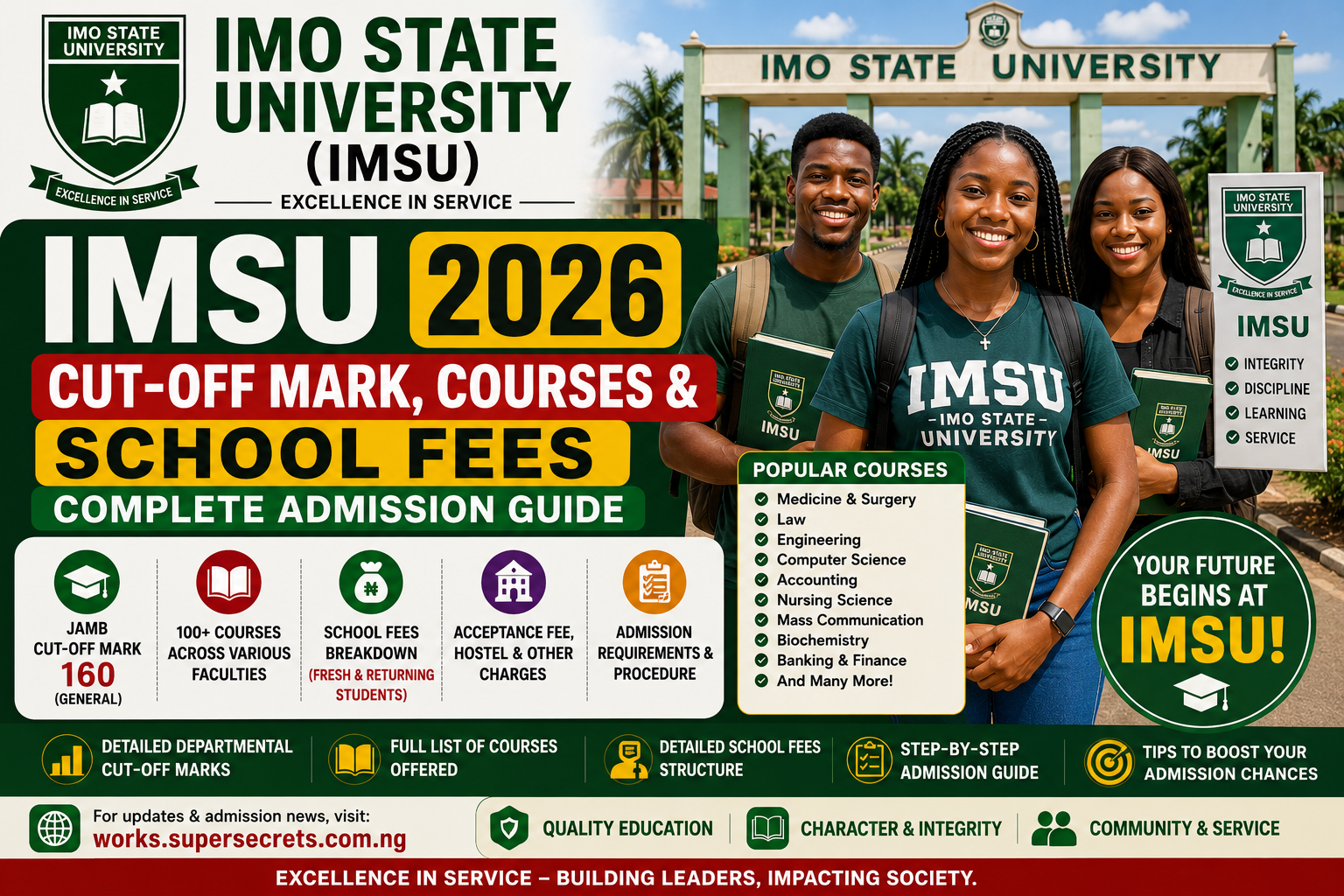
IMSU pegged its general UTME cut-off at 160 for the 2026/2027 session — a notch above the national floor of 150 that JAMB approved at its May 11, 2026 Policy Meeting. The slightly raised baseline reflects the demand IMSU sees every year as one of the South-East’s most sought-after state universities.
As ever, 160 is the eligibility line, not the finish line. IMSU’s flagship courses — Medicine first, then Law, Pharmacy, Nursing — operate on much higher departmental benchmarks. A 160 will work comfortably for many education, agriculture, and humanities programmes; it won’t come anywhere near Medicine, which realistically needs 250+.
IMSU Departmental Cut-Off Marks For 2026 (Estimated)
These figures show how competitive each programme typically runs. They’re estimates from past admission patterns and can move a little year to year.
| Course/Department | Estimated JAMB Cut-Off | Aggregate Needed |
|---|---|---|
| Medicine and Surgery (MBBS) | 260 – 290 | 70+ |
| Pharmacy | 240 – 270 | 67+ |
| Nursing Science | 240 – 270 | 67+ |
| Dentistry | 240 – 270 | 67+ |
| Medical Laboratory Science | 220 – 250 | 63+ |
| Physiotherapy | 210 – 240 | 61+ |
| Optometry | 210 – 240 | 61+ |
| Anatomy | 190 – 220 | 57+ |
| Physiology | 190 – 220 | 57+ |
| Law (LLB) | 240 – 270 | 66+ |
| Civil Engineering | 200 – 230 | 59+ |
| Mechanical Engineering | 190 – 220 | 57+ |
| Electrical/Electronics Engineering | 200 – 230 | 59+ |
| Computer Engineering | 200 – 230 | 59+ |
| Chemical Engineering | 190 – 220 | 57+ |
| Computer Science | 210 – 240 | 61+ |
| Software Engineering | 210 – 240 | 61+ |
| Accounting | 200 – 230 | 59+ |
| Banking and Finance | 185 – 210 | 55+ |
| Business Administration | 185 – 210 | 55+ |
| Economics | 190 – 220 | 56+ |
| Mass Communication | 210 – 240 | 61+ |
| Political Science | 180 – 205 | 54+ |
| Sociology | 175 – 195 | 52+ |
| Psychology | 185 – 205 | 54+ |
| English and Literary Studies | 180 – 200 | 53+ |
| Linguistics/Igbo | 160 – 180 | 50+ |
| History and International Studies | 165 – 185 | 50+ |
| Philosophy | 160 – 180 | 50+ |
| Theatre Arts | 170 – 190 | 51+ |
| Microbiology | 195 – 220 | 57+ |
| Biochemistry | 195 – 220 | 57+ |
| Chemistry | 175 – 195 | 52+ |
| Physics | 175 – 195 | 52+ |
| Mathematics | 165 – 185 | 50+ |
| Geology | 175 – 195 | 52+ |
| Architecture | 195 – 220 | 57+ |
| Estate Management | 175 – 195 | 52+ |
| Agriculture | 160 – 180 | 50+ |
| Education (various) | 160 – 185 | 50+ |
If your score is in the 160–190 band, your strongest options are the Education programmes, Agriculture, Igbo/Linguistics, History, Philosophy, Mathematics, and some sciences. Medicine, Law, Pharmacy, Nursing and Dentistry all demand 240+ — be realistic if your score doesn’t reach there.
IMSU decides final admission on an aggregate of UTME and Post-UTME, calculated along the lines our UNIOSUN cut-off calculation guide explains step by step.
Courses Available At IMSU
IMSU’s catalogue is extensive. By faculty:
Faculty of Medicine / College of Medicine and Health Sciences
- Medicine and Surgery (MBBS)
- Dentistry
- Pharmacy
- Nursing Science
- Medical Laboratory Science
- Physiotherapy
- Optometry
- Human Anatomy
- Human Physiology
- Public Health
Faculty of Law
- Public Law
- Private and Property Law
- International Law and Jurisprudence
Faculty of Engineering
- Civil Engineering
- Mechanical Engineering
- Electrical/Electronics Engineering
- Computer Engineering
- Chemical Engineering
- Agricultural Engineering
Faculty of Science
- Computer Science
- Software Engineering
- Mathematics
- Statistics
- Physics
- Chemistry
- Microbiology
- Biochemistry
- Botany
- Zoology
- Geology
- Industrial Chemistry
Faculty of Environmental Sciences
- Architecture
- Estate Management
- Surveying and Geoinformatics
- Urban and Regional Planning
- Building
Faculty of Social Sciences
- Economics
- Political Science
- Sociology
- Psychology
- Geography and Environmental Management
Faculty of Business Administration / Management Sciences
- Accounting
- Banking and Finance
- Business Administration
- Marketing
- Insurance
- Management
Faculty of Humanities
- English and Literary Studies
- History and International Studies
- Linguistics and Igbo
- Philosophy
- Religious Studies
- Theatre Arts
- Mass Communication
- Foreign Languages
Faculty of Agriculture and Veterinary Medicine
- Agricultural Economics and Extension
- Animal Science
- Crop Science
- Soil Science
- Fisheries
- Forestry
Faculty of Education
- Educational Foundations and Administration
- Guidance and Counselling
- Science Education
- Arts and Social Science Education
- Library and Information Science
- Adult and Continuing Education
A Postgraduate School rounds it out with Masters and PhD programmes across the faculties.
That comprehensive spread, combined with a teaching hospital, keeps IMSU near the top of the South-East’s most-applied-to universities every year.
IMSU School Fees For 2026
As a state university, IMSU’s fees fall between the cheap federal rates and the steeper private-university bills — and as always with state schools, Imo indigenes pay less than non-indigenes.
Freshers (100 Level) — Tuition Per Session
| Faculty/Course | Imo Indigene (₦) | Non-Indigene (₦) |
|---|---|---|
| Education/Humanities | ₦90,000 – ₦140,000 | ₦150,000 – ₦220,000 |
| Social Sciences | ₦110,000 – ₦160,000 | ₦170,000 – ₦240,000 |
| Management Sciences | ₦110,000 – ₦160,000 | ₦170,000 – ₦240,000 |
| Sciences | ₦130,000 – ₦190,000 | ₦200,000 – ₦280,000 |
| Computer Science | ₦150,000 – ₦210,000 | ₦220,000 – ₦300,000 |
| Engineering | ₦170,000 – ₦240,000 | ₦250,000 – ₦340,000 |
| Environmental Sciences | ₦150,000 – ₦210,000 | ₦220,000 – ₦300,000 |
| Law (LLB) | ₦180,000 – ₦260,000 | ₦270,000 – ₦370,000 |
| Pharmacy | ₦220,000 – ₦310,000 | ₦330,000 – ₦440,000 |
| Nursing/Medical Lab | ₦200,000 – ₦290,000 | ₦300,000 – ₦420,000 |
| Medicine, Dentistry | ₦300,000 – ₦420,000 | ₦440,000 – ₦620,000 |
| Agriculture | ₦100,000 – ₦150,000 | ₦160,000 – ₦230,000 |
Returning Students (200 Level+) — Tuition Per Session
| Faculty/Course | Imo Indigene (₦) | Non-Indigene (₦) |
|---|---|---|
| Education/Humanities | ₦70,000 – ₦110,000 | ₦120,000 – ₦180,000 |
| Social/Management Sciences | ₦85,000 – ₦130,000 | ₦140,000 – ₦200,000 |
| Sciences | ₦100,000 – ₦150,000 | ₦160,000 – ₦230,000 |
| Engineering | ₦140,000 – ₦200,000 | ₦210,000 – ₦290,000 |
| Law | ₦150,000 – ₦220,000 | ₦230,000 – ₦320,000 |
| Pharmacy/Medicine | ₦250,000 – ₦370,000 | ₦380,000 – ₦540,000 |
| Nursing/Medical Lab | ₦170,000 – ₦250,000 | ₦260,000 – ₦370,000 |
Fees are per session. The indigene saving is substantial — Imo indigenes often pay close to half what non-indigenes do for the same course. To compare against the federal route, our UNILAG 100-level fees guide shows where a federal university sits; IMSU runs higher than federal but stays well under private-university pricing.
Other Costs At IMSU
| Item | Estimate (₦) |
|---|---|
| Acceptance fee (freshers) | ₦30,000 – ₦55,000 |
| Post-UTME/screening fee | ₦2,500 – ₦4,000 |
| ICT/technology fee | ₦8,000 – ₦15,000 |
| Examination fee | ₦8,000 – ₦14,000 |
| Departmental/faculty dues | ₦5,000 – ₦12,000 |
| SUG dues | ₦2,000 – ₦5,000 |
| Hostel (per session) | ₦25,000 – ₦55,000 |
| Health/medical fee | ₦5,000 – ₦12,000 |
| ID card | ₦2,000 – ₦5,000 |
| Books & materials | ₦40,000 – ₦90,000 |
| Feeding (monthly) | ₦25,000 – ₦55,000 |
Putting it together, a non-medical indigene fresher should budget around ₦250,000 – ₦480,000 for the first session, with non-indigenes and medical students landing higher — medical freshers can reach ₦550,000 – ₦800,000+ all-in.
Admission Requirements And The Application Route
IMSU’s requirements are the familiar state-university template. You’ll need a 2026 UTME score of at least 160 (much higher for the competitive courses), with IMSU as your first choice. On O’Level, five credits in not more than two sittings including English and Maths, plus three subjects relevant to your course — the health sciences want Physics, Chemistry and Biology; Law wants Literature and Government; the management courses want Economics.
IMSU runs a compulsory Post-UTME screening, and accepts Direct Entry candidates holding IJMB, JUPEB, A-Levels, ND, HND or NCE qualifications with the O’Level requirements.
The route through: register and sit JAMB with IMSU first → clear the cut-off and apply for Post-UTME on the IMSU portal (imsu.edu.ng), paying the screening fee → sit the Post-UTME → check JAMB CAPS and the IMSU portal for your offer and accept it → pay the acceptance fee → settle session fees, register, sort accommodation, and resume.
Improving Your Odds At IMSU
Given IMSU’s popularity, the competition for top courses is stiff, so strategy counts. Push your score well above 160 — 230+ for the strong courses, 260+ for Medicine — because the aggregate filters out borderline candidates quickly. Take the Post-UTME seriously; it’s a major part of the final ranking. Keep your O’Level grades strong, particularly the sciences if you’re chasing a health course. List IMSU first, and if you’re an Imo indigene you gain both cheaper fees and catchment advantage. And if your score is moderate, choose a realistically attainable course — IMSU has plenty of solid programmes beyond the over-subscribed ones, so don’t pin everything on Medicine and risk losing the session.
For wider South-East context, our COOU cut-off guide and ABSU cut-off guide show how IMSU’s neighbours handle their admissions.
IMSU Accommodation
| Hostel Type | Per Session (₦) |
|---|---|
| Male hostels | ₦25,000 – ₦45,000 |
| Female hostels | ₦30,000 – ₦55,000 |
| Postgraduate hostels | ₦45,000 – ₦65,000 |
| Off-campus (Owerri) | ₦120,000 – ₦350,000 yearly |
On-campus bed space falls well short of demand at a school IMSU’s size, so a large share of students — particularly beyond first year — live off-campus around Owerri. The city has a huge student housing market, and rents are moderate compared to Lagos or Port Harcourt.
IMSU FAQs
Federal or state? State — owned by the Imo State Government, established 1981, based in Owerri.
2026 cut-off? 160 general, with Medicine, Law, Pharmacy and Nursing demanding far higher departmental scores.
Can 160 get me in? For Education, Agriculture, Igbo, History and some sciences, yes. Medicine, Law and Pharmacy need 240+.
Does IMSU offer Medicine? Yes — IMSU has a College of Medicine and Health Sciences with a teaching hospital, offering Medicine, Dentistry, Pharmacy and Nursing.
Is there a Post-UTME? Yes — a compulsory Post-UTME screening for eligible candidates.
Indigene vs non-indigene fees? Imo indigenes pay considerably less — often close to half the non-indigene rate.
Medicine fees? Roughly ₦300,000–₦420,000 (indigene) or ₦440,000–₦620,000 (non-indigene) per session in tuition, plus other costs.
How is admission decided? On an aggregate of your UTME and Post-UTME, with O’Level and choice status factored in.
Is hostel guaranteed? No — demand far outstrips bed space, and most students rent off-campus in Owerri.
What’s IMSU best known for? Medicine, Law, the health sciences, and a strong tradition in the arts and social sciences — plus being one of the South-East’s most popular state universities.
Final Take
Imo State University has earned its place as a South-East institution of choice through decades of comprehensive, accessible education and a steady stream of graduates across every field. For 2026, the message for applicants is clear: the 160 cut-off opens the door, but the popular courses are fiercely contested, and the Post-UTME is where serious candidates separate themselves from the pack.
Plan on ₦250,000 – ₦480,000 for a first-year indigene in a non-medical course, with non-indigenes and medical students budgeting more. Aim well past the minimum for any competitive programme, give the Post-UTME your full effort, keep your O’Level grades clean, and put IMSU first. As always, verify the latest cut-off marks, fees and Post-UTME dates on the official JAMB portal and the IMSU portal before applying, since the numbers shift each session.
For a well-prepared candidate — and especially an Imo indigene — IMSU delivers strong, comprehensive education at state-university cost, in a city built around student life.