Federal University Of Health Sciences Otukpo (FUHSO) 2026: Cut-Off Mark, Courses, School Fees & Admission Requirements
Nigeria has dozens of universities that teach medicine, but only a small handful that exist purely for the health sciences. The Federal University of Health Sciences, Otukpo is one of them — a specialised federal institution built from the ground up to train doctors, nurses, pharmacists, and allied health professionals. For students whose ambitions point firmly toward a career in healthcare, FUHSO is a school designed entirely around that goal.
This guide lays out what 2026 applicants need: the cut-off mark, departmental scores, the full course list, an affordable federal fee breakdown, and how to apply.
What FUHSO Is And Why It Exists
The Federal University of Health Sciences, Otukpo — abbreviated FUHSO — is a federal government-owned university located in Otukpo, Benue State, in Nigeria’s North-Central / Middle Belt region. It was established in 2021 as part of a federal initiative to create dedicated universities of health sciences, expanding the country’s capacity to train desperately-needed medical and healthcare professionals.
Unlike conventional universities that offer health sciences as one faculty among many, FUHSO is a specialised health-sciences university — its entire focus is medicine, nursing, pharmacy, the basic medical sciences, and allied health disciplines. That singular focus means concentrated resources, purpose-built facilities, and an academic environment geared entirely toward healthcare training.
As a young federal university, FUHSO is still developing its campus and expanding its programmes, but it carries the major advantages every federal university enjoys: very affordable fees, federal recognition, and access to federal resources. For a health-focused student, that combination — specialisation plus federal affordability — is genuinely attractive.
For comparison with other health-focused and federal options, our Rhema University nursing fees guide covers a private health-sciences-focused institution, and the YABATECH medical courses guide is useful for comparing health-programme admissions. The UNIOSUN cut-off calculation guide explains the aggregate scoring approach.
FUHSO’s 2026 Cut-Off Mark
FUHSO set its general UTME cut-off at 150 for the 2026/2027 session, matching the national minimum approved at JAMB’s May 11, 2026 Policy Meeting. As a federal university, that’s the baseline eligibility figure.
But here’s the crucial reality for a health-sciences university: because nearly every programme at FUHSO is a competitive, regulated health course, the departmental cut-offs are what really matter, and they sit well above 150. Medicine is regulated by the MDCN and demands very high scores; Nursing, Pharmacy, and the allied health sciences follow close behind. At a school like FUHSO, you should think much less about the 150 floor and much more about the genuinely competitive departmental benchmarks below.
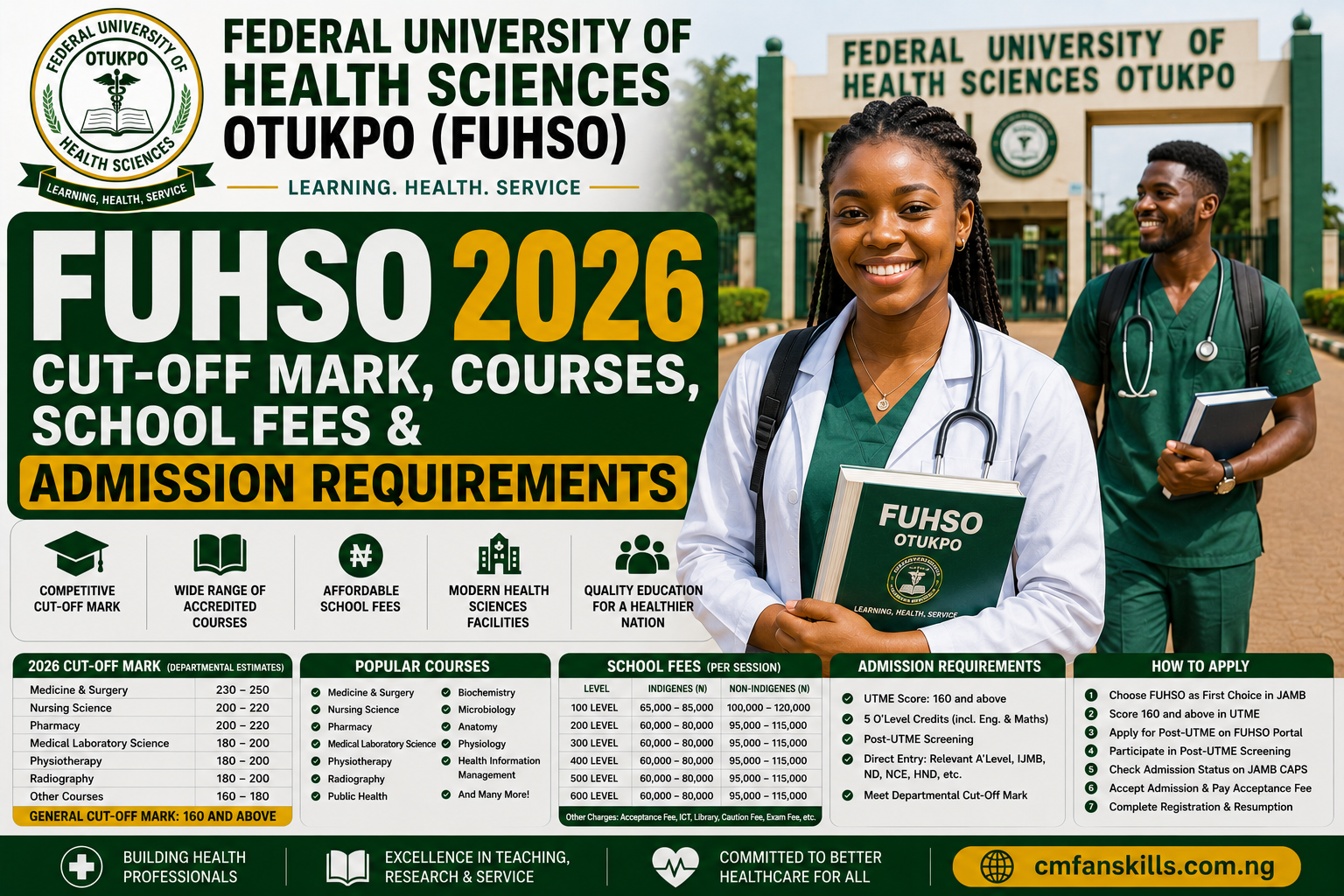
FUHSO Departmental Cut-Off Marks For 2026 (Estimated)
These figures reflect how competitive each health programme typically runs. They’re estimates from past patterns and can move with each year’s applicant pool.
| Course/Department | Estimated JAMB Cut-Off | Aggregate Needed |
|---|---|---|
| Medicine and Surgery (MBBS) | 240 – 270 | 66+ |
| Dentistry (where available) | 230 – 260 | 64+ |
| Pharmacy | 220 – 250 | 62+ |
| Nursing Science | 220 – 250 | 62+ |
| Medical Laboratory Science | 200 – 230 | 58+ |
| Physiotherapy | 200 – 230 | 58+ |
| Radiography | 195 – 225 | 57+ |
| Optometry | 195 – 225 | 57+ |
| Human Anatomy | 180 – 210 | 54+ |
| Human Physiology | 180 – 210 | 54+ |
| Medical Biochemistry | 180 – 205 | 53+ |
| Public/Community Health | 175 – 200 | 52+ |
| Nutrition and Dietetics | 175 – 200 | 52+ |
| Environmental Health Science | 165 – 190 | 50+ |
| Health Information Management | 160 – 185 | 50+ |
| Pharmacology | 180 – 205 | 53+ |
| Microbiology | 175 – 200 | 52+ |
| Biochemistry (basic science) | 170 – 195 | 51+ |
The pattern is clear: even FUHSO’s “easier” programmes start around 160–175, and the flagship courses (Medicine, Pharmacy, Nursing) demand 220+. If your score is below 200, your most realistic FUHSO routes are the allied and basic health sciences — Environmental Health, Health Information Management, Anatomy, Physiology, Public Health — rather than Medicine. Be strategic and honest about where your score lands.
FUHSO sets final admission on an aggregate of UTME and Post-UTME, calculated along the lines our UNIOSUN cut-off calculation guide describes.
Courses Offered At FUHSO
FUHSO’s catalogue is, by design, entirely health-focused. By college/faculty:
College of Medicine / Clinical Sciences
- Medicine and Surgery (MBBS)
- Dentistry (developing/where accredited)
Faculty of Pharmacy
- Pharmacy (PharmD/B.Pharm)
Faculty of Nursing Sciences
- Nursing Science
Faculty of Allied Health Sciences
- Medical Laboratory Science
- Physiotherapy
- Radiography
- Optometry
- Nutrition and Dietetics
- Environmental Health Science
- Health Information Management
- Public/Community Health
Faculty of Basic Medical Sciences
- Human Anatomy
- Human Physiology
- Medical Biochemistry
- Pharmacology
Faculty of Basic Clinical Sciences
- Pathology-related and other pre-clinical disciplines (as programmes develop)
Postgraduate Programmes — developing across the health-sciences disciplines as the university matures.
As a young, specialised university, FUHSO continues to add and seek accreditation for programmes, so always confirm the current accredited course list on the official portal before applying. The key point: every path here leads into healthcare — there are no arts, engineering, or general management programmes.
FUHSO School Fees For 2026
Here’s a major advantage of FUHSO being federal: its fees are very affordable, a fraction of what private health-sciences programmes cost. As a federal university, fees don’t carry an indigene/non-indigene split the way state universities do — they’re broadly uniform, though health programmes naturally cost a little more than basic sciences because of laboratory and clinical expenses.
Freshers (100 Level) — Approximate Per Session
| Course Group | Tuition + Mandatory Charges (₦) |
|---|---|
| Basic/Allied Health Sciences (Anatomy, Physiology, Public Health, Health Info Mgt, Environmental Health) | ₦70,000 – ₦130,000 |
| Nutrition, Medical Lab, Physiotherapy, Radiography, Optometry | ₦100,000 – ₦170,000 |
| Nursing Science | ₦120,000 – ₦200,000 |
| Pharmacy | ₦130,000 – ₦220,000 |
| Medicine and Surgery (MBBS) | ₦150,000 – ₦280,000 |
Returning Students (200 Level+) — Approximate Per Session
| Course Group | Per Session (₦) |
|---|---|
| Basic/Allied Health Sciences | ₦50,000 – ₦100,000 |
| Medical Lab, Physiotherapy, Radiography | ₦75,000 – ₦140,000 |
| Nursing Science | ₦90,000 – ₦160,000 |
| Pharmacy | ₦100,000 – ₦180,000 |
| Medicine (MBBS) | ₦120,000 – ₦230,000 |
Fees run per session and bundle the major mandatory charges. Even FUHSO’s most expensive programme — Medicine — costs a tiny fraction of what a private university charges for the same degree. To see just how stark that contrast is, our Rhema University nursing fees guide shows private health-programme pricing, while the UNILAG 100-level fees guide gives a federal benchmark. FUHSO offers genuinely affordable medical training.
Other Costs At FUHSO
| Item | Estimate (₦) |
|---|---|
| Acceptance fee (freshers) | ₦25,000 – ₦50,000 |
| Post-UTME/screening fee | ₦2,000 – ₦4,000 |
| ICT/technology fee | ₦8,000 – ₦15,000 |
| Examination fee | ₦8,000 – ₦14,000 |
| Laboratory/clinical fee | ₦10,000 – ₦25,000 |
| Departmental/faculty dues | ₦4,000 – ₦10,000 |
| SUG dues | ₦2,000 – ₦4,000 |
| Hostel (per session) | ₦20,000 – ₦45,000 |
| Health/medical fee | ₦5,000 – ₦12,000 |
| ID card | ₦2,000 – ₦4,000 |
| Books, instruments & materials | ₦40,000 – ₦100,000 |
| Feeding (monthly) | ₦25,000 – ₦50,000 |
A first-year student should budget around ₦200,000 – ₦450,000 for the first session depending on the programme, with Medicine and Pharmacy at the higher end due to clinical materials, lab fees, and instruments. Otukpo’s moderate cost of living helps keep the overall budget reasonable — and remember, the tuition itself remains very affordable thanks to federal status.
Admission Requirements And How To Apply
FUHSO’s requirements are health-sciences-specific and fairly demanding on the science side. You’ll need a 2026 UTME score of at least 150 (far higher for the competitive courses), with FUHSO as first choice. Crucially, almost every programme requires the science combination: on O’Level, five credits in not more than two sittings including English, Mathematics, Physics, Chemistry, and Biology — the standard requirement for medical and health-sciences courses. JAMB subjects must include Physics, Chemistry, and Biology alongside English.
FUHSO runs a compulsory Post-UTME screening and accepts Direct Entry candidates with strong A-Levels, IJMB, JUPEB, ND (in relevant health/science fields), or other recognised qualifications alongside the science O’Level requirements.
The route: register and sit JAMB with FUHSO first and the correct science subject combination → clear the cut-off and apply for Post-UTME on the FUHSO portal (fuhso.edu.ng), paying the screening fee → sit the Post-UTME → check JAMB CAPS and the FUHSO portal for your offer and accept it → pay the acceptance fee → settle session fees, register, sort accommodation, and resume.
Tips For FUHSO Applicants
FUHSO is unusual in this series because there are no “easy” backup courses outside the health field — everything is competitive and science-based. So preparation matters enormously. Aim well above the minimum: 240+ if Medicine is the goal, 220+ for Pharmacy and Nursing, and a solid 175+ even for the allied and basic health sciences. Your science grades are non-negotiable — strong O’Level results in Physics, Chemistry, and Biology are essential, and the Post-UTME (heavily science-weighted) is where serious candidates pull ahead. List FUHSO first. And be strategic: if Medicine is a stretch for your score, a strong allied-health programme (Medical Lab Science, Physiotherapy, Radiography, Public Health) is a genuinely rewarding healthcare career and a realistic entry point — far better than missing the session entirely chasing a course beyond reach.
For comparison on how health programmes are structured elsewhere, our YABATECH medical courses guide is a useful companion.
FUHSO Accommodation
| Hostel Type | Per Session (₦) |
|---|---|
| Male hostels | ₦20,000 – ₦38,000 |
| Female hostels | ₦22,000 – ₦45,000 |
| Off-campus (Otukpo) | ₦80,000 – ₦220,000 yearly |
As a young university still expanding, FUHSO’s on-campus bed space is limited, so many students rent off-campus around Otukpo, where accommodation is reasonably affordable. The town is a calm, manageable environment well suited to the focused, demanding nature of health-sciences study.
FUHSO FAQs
Federal or state? Federal — owned by the Federal Government of Nigeria, established 2021, located in Otukpo, Benue State.
What kind of university is FUHSO? A specialised federal university of health sciences — its entire focus is medicine, nursing, pharmacy, and allied/basic health sciences. It offers no arts, engineering, or general management programmes.
2026 cut-off? 150 general, but because every programme is a competitive health course, the departmental cut-offs (160–270) are what truly matter.
Can 150 get me in? 150 only makes you eligible. Even the most accessible FUHSO programmes start around 160–175, and Medicine needs 240+. Aim much higher than the floor.
Does FUHSO offer Medicine? Yes — Medicine and Surgery (MBBS) is a flagship programme, alongside Pharmacy, Nursing, and the allied health sciences.
How affordable is FUHSO? Very — as a federal university, even Medicine costs a small fraction of private-university pricing.
Is there a Post-UTME? Yes — a compulsory, science-weighted Post-UTME screening.
What O’Level subjects do I need? For nearly all programmes: English, Mathematics, Physics, Chemistry, and Biology.
What if my score isn’t high enough for Medicine? Consider the allied health sciences (Medical Lab Science, Physiotherapy, Radiography, Public Health) — rewarding healthcare careers with more accessible entry points.
Is hostel guaranteed? No — as a young university, bed space is limited, but Otukpo off-campus housing is affordable.
Final Take
The Federal University of Health Sciences, Otukpo represents a focused, forward-looking idea — a federal university dedicated entirely to producing the doctors, nurses, pharmacists, and allied health professionals Nigeria urgently needs. For a student whose heart is set on healthcare, that specialisation, combined with affordable federal fees, makes FUHSO a genuinely compelling choice.
For 2026, treat the 150 cut-off as mere eligibility — the real benchmarks are the competitive departmental scores, with Medicine at 240+ and even allied health sciences starting around 160–175. Budget around ₦200,000 – ₦450,000 for the first session depending on programme, remembering that federal status keeps even Medicine remarkably affordable. Nail your science grades, take the Post-UTME seriously, list FUHSO first, and choose a programme that genuinely matches your score — there’s no shame, and real reward, in entering healthcare through the allied sciences. As always, verify the current cut-off marks, fees, accredited programmes, and Post-UTME dates on the official JAMB portal and the FUHSO portal before applying, since the figures shift each session.
If healthcare is your calling and affordability matters, FUHSO is one of the most purpose-built — and underrated — choices in the country.