Plateau State University (PLASU) Cut-Off Mark, Courses & School Fees For 2026 Aspirants
The cool highlands of Plateau State — where the climate is gentler than almost anywhere else in Nigeria — are home to a state university that has grown steadily into a dependable choice for Middle Belt students. Plateau State University, sited in the town of Bokkos rather than the busy state capital, offers an affordable, accessible route into higher education in one of the country’s most scenic regions. It’s not the biggest or the oldest, but for the right student, it delivers exactly what’s needed.
Here’s the full 2026 picture for PLASU hopefuls: the cut-off mark, departmental scores, the complete course list, a clear fee breakdown, and how to apply.
Getting To Know Plateau State University
Plateau State University, known as PLASU, is owned by the Plateau State Government and located in Bokkos, Bokkos Local Government Area, Plateau State, in Nigeria’s North-Central / Middle Belt region. It was established in 2005, placing it among the newer-generation state universities, and — like a few other state schools — it was deliberately sited away from the state capital (Jos) to spread development and educational access to a more rural part of the state.
PLASU operates from its campus in Bokkos and offers programmes across faculties covering the Natural Sciences, Social Sciences, Arts/Humanities, Management Sciences, Education, and increasingly the health and medical sciences. Despite its relatively young age and rural setting, the university has built up its programmes steadily and serves a growing student population from across Plateau and the wider Middle Belt.
The Bokkos location comes with a genuine perk: Plateau’s famously cool, temperate highland climate makes it one of the most comfortable study environments in Nigeria, and the rural setting keeps living costs low and distractions few.
For comparison with other institutions, our University of Ilorin guide covers a major federal university in the broader North-Central zone, and the UNIOSUN cut-off calculation guide explains the aggregate scoring PLASU and other state universities use.
PLASU’s 2026 Cut-Off Mark
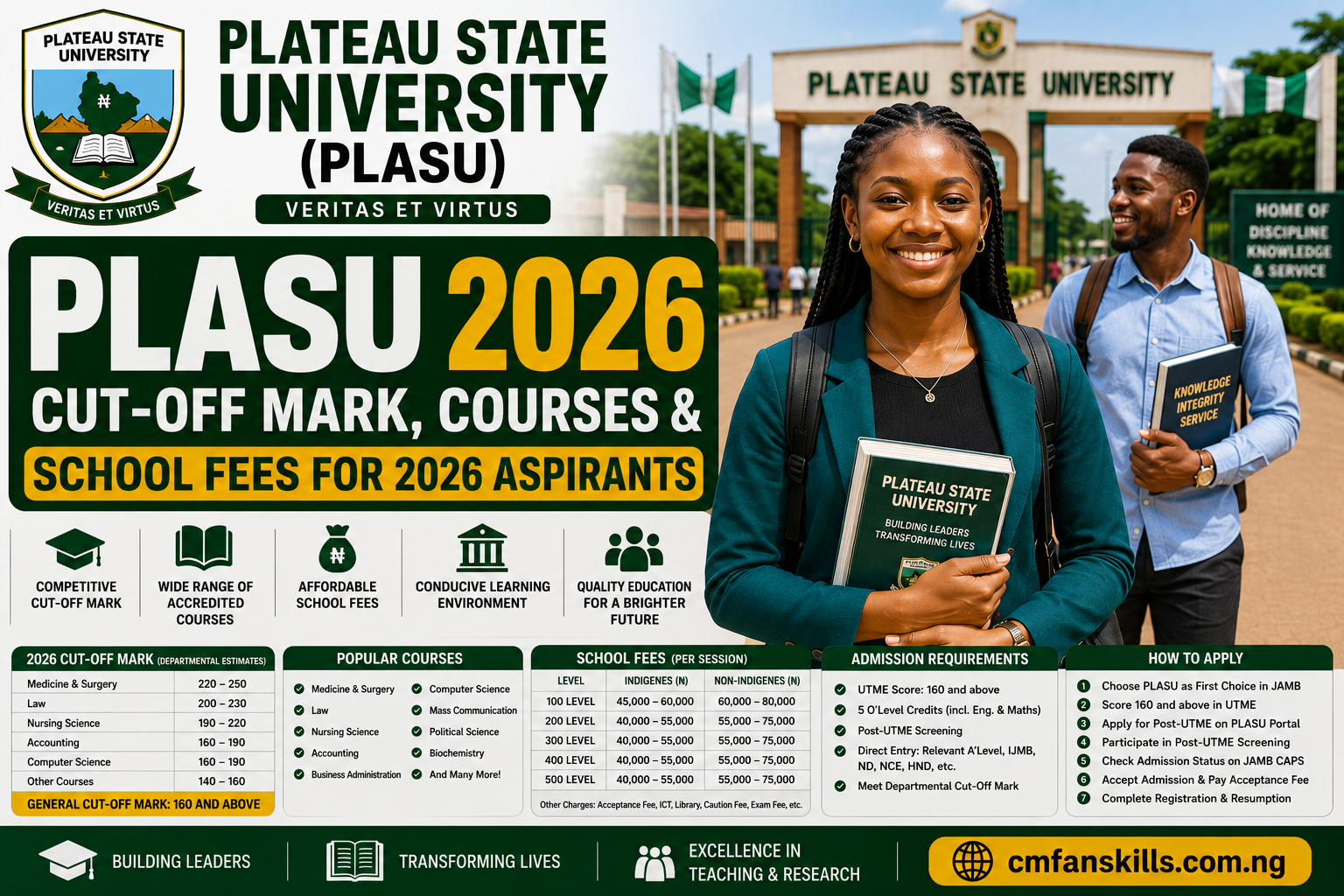
Plateau State University set its general UTME cut-off at 150 for the 2026/2027 session, matching the national minimum approved at JAMB’s May 11, 2026 Policy Meeting. As a state university focused on widening access, PLASU keeps its baseline accessible — good news for candidates with moderate JAMB scores.
The standard note applies: 150 makes you eligible, while the more in-demand programmes — any medical or health sciences, plus Computer Science, Accounting, and Mass Communication — set higher benchmarks. But across PLASU’s education, arts, and social science catalogue, a score around 150–170 is realistically workable.
PLASU Departmental Cut-Off Marks For 2026 (Estimated)
These guideline figures reflect typical competitiveness. They’re estimates from past patterns and can shift slightly each session.
| Course/Department | Estimated JAMB Cut-Off | Competitiveness |
|---|---|---|
| Medicine/Health Sciences (where available) | 210 – 250 | High |
| Nursing Science (where available) | 200 – 230 | High |
| Public Health | 175 – 200 | Moderate-high |
| Computer Science | 180 – 205 | Moderate-high |
| Information Technology | 165 – 190 | Moderate |
| Accounting | 175 – 200 | Moderate-high |
| Banking and Finance | 160 – 185 | Accessible |
| Business Administration | 160 – 185 | Accessible |
| Economics | 170 – 195 | Moderate |
| Public Administration | 155 – 180 | Accessible |
| Political Science | 165 – 190 | Moderate |
| Sociology | 155 – 180 | Accessible |
| Mass Communication | 180 – 205 | Moderate-high |
| English | 160 – 185 | Accessible |
| History and International Studies | 150 – 175 | Accessible |
| Religious Studies (Christian/Islamic) | 150 – 170 | Accessible |
| Philosophy | 150 – 170 | Accessible |
| Languages/Linguistics | 150 – 175 | Accessible |
| Microbiology | 175 – 200 | Moderate-high |
| Biochemistry | 175 – 200 | Moderate-high |
| Biology | 160 – 185 | Accessible |
| Chemistry | 155 – 180 | Accessible |
| Physics | 155 – 180 | Accessible |
| Mathematics | 150 – 175 | Accessible |
| Statistics | 150 – 175 | Accessible |
| Geology | 160 – 185 | Accessible |
| Zoology / Botany | 155 – 180 | Accessible |
| Agriculture/Agric Economics | 150 – 175 | Accessible |
| Education (Science) | 150 – 175 | Accessible |
| Education (Arts) | 150 – 170 | Accessible |
| Education (Social Science) | 150 – 170 | Accessible |
| Library and Information Science | 150 – 170 | Accessible |
If your score lands in the 150–180 band, the bulk of PLASU’s catalogue is within reach — the Education programmes, Agriculture, the Arts (History, Religious Studies, Philosophy, Languages), the social sciences, and the basic sciences. The health sciences, Computer Science, Accounting, Mass Communication, Microbiology, and Biochemistry are the ones to aim higher for.
PLASU sets final admission on an aggregate of UTME and Post-UTME, calculated as our UNIOSUN cut-off calculation guide explains.
Courses Offered At PLASU
PLASU’s catalogue covers the core faculties, with steady expansion over time. By faculty:
Faculty of Natural Sciences
- Computer Science
- Information Technology
- Mathematics
- Statistics
- Physics
- Chemistry
- Microbiology
- Biochemistry
- Biology / Botany / Zoology
- Geology
- Industrial Chemistry
Faculty of Medical / Health Sciences (developing)
- Nursing Science
- Public Health
- Medical Laboratory Science (where accredited)
- Anatomy / Physiology (where accredited)
Faculty of Social Sciences
- Economics
- Political Science
- Sociology
- Public Administration
- Mass Communication
- Geography
Faculty of Management Sciences
- Accounting
- Banking and Finance
- Business Administration
Faculty of Arts / Humanities
- English and Literary Studies
- History and International Studies
- Religious Studies (Christian and Islamic)
- Philosophy
- Languages and Linguistics
- Theatre Arts
Faculty of Agriculture
- Agricultural Economics and Extension
- Animal Science
- Crop Production
- Soil Science
Faculty of Education
- Educational Foundations
- Science Education
- Arts and Social Science Education
- Guidance and Counselling
- Library and Information Science
A Postgraduate School offers Masters and PhD programmes across the established faculties.
As a younger university, PLASU continues adding programmes, so always confirm the current accredited list on the official portal before applying — particularly for the developing health and medical sciences.
PLASU School Fees For 2026
As a state university focused on access, PLASU’s fees are affordable. The indigene versus non-indigene distinction applies, with Plateau State indigenes paying less.
Freshers (100 Level) — Tuition Per Session
| Faculty/Course | Plateau Indigene (₦) | Non-Indigene (₦) |
|---|---|---|
| Education | ₦55,000 – ₦95,000 | ₦100,000 – ₦160,000 |
| Arts/Humanities | ₦55,000 – ₦95,000 | ₦100,000 – ₦160,000 |
| Social/Management Sciences | ₦70,000 – ₦115,000 | ₦120,000 – ₦185,000 |
| Sciences | ₦90,000 – ₦145,000 | ₦155,000 – ₦230,000 |
| Computer Science | ₦105,000 – ₦165,000 | ₦175,000 – ₦250,000 |
| Health Sciences (where available) | ₦130,000 – ₦200,000 | ₦210,000 – ₦310,000 |
Returning Students (200 Level+) — Tuition Per Session
| Faculty/Course | Plateau Indigene (₦) | Non-Indigene (₦) |
|---|---|---|
| Education/Arts | ₦40,000 – ₦75,000 | ₦80,000 – ₦135,000 |
| Social/Management Sciences | ₦55,000 – ₦95,000 | ₦100,000 – ₦160,000 |
| Sciences | ₦70,000 – ₦115,000 | ₦120,000 – ₦190,000 |
| Computer Science | ₦90,000 – ₦140,000 | ₦150,000 – ₦220,000 |
| Health Sciences | ₦110,000 – ₦170,000 | ₦180,000 – ₦270,000 |
Fees run per session. The indigene discount is significant — often around half the non-indigene rate for the same course — and Bokkos’s low rural cost of living keeps the overall budget down. For the federal comparison, our UNILAG 100-level fees guide shows where a federal university lands; PLASU sits above federal but moderate among state universities.
Other Costs At PLASU
| Item | Estimate (₦) |
|---|---|
| Acceptance fee (freshers) | ₦25,000 – ₦45,000 |
| Post-UTME/screening fee | ₦2,000 – ₦3,500 |
| ICT/technology fee | ₦7,000 – ₦13,000 |
| Examination fee | ₦7,000 – ₦12,000 |
| Departmental/faculty dues | ₦4,000 – ₦9,000 |
| SUG dues | ₦1,500 – ₦4,000 |
| Hostel (per session) | ₦18,000 – ₦40,000 |
| Health/medical fee | ₦4,000 – ₦10,000 |
| ID card | ₦2,000 – ₦4,000 |
| Books & materials | ₦30,000 – ₦70,000 |
| Feeding (monthly) | ₦20,000 – ₦45,000 |
Altogether, a first-year indigene should budget around ₦180,000 – ₦350,000 for the first session, with non-indigenes somewhat higher. Bokkos’s rural highland setting keeps living costs low, making PLASU one of the more affordable universities to attend.
Admission Requirements And How To Apply
PLASU’s requirements follow the state-university template. A 2026 UTME score of at least 150 (higher for the health sciences, Computer Science, Accounting and Mass Communication), with PLASU as first choice. On O’Level, five credits in not more than two sittings including English and Maths, plus three subjects relevant to your course — the sciences want Chemistry, Biology and Physics; the management courses want Economics; Mass Communication wants English and Literature; education-subject combinations need a credit in the subject you intend to teach.
PLASU runs a Post-UTME/screening exercise and accepts Direct Entry candidates with IJMB, JUPEB, A-Levels, ND, or NCE qualifications alongside the O’Level requirements.
The route: register and sit JAMB with PLASU first → clear the cut-off and apply for Post-UTME on the PLASU portal (plasu.edu.ng), paying the screening fee → sit the screening → check JAMB CAPS and the PLASU portal for your offer and accept it → pay the acceptance fee → settle session fees, register, sort accommodation, and resume.
Tips For PLASU Applicants
With an accessible cut-off, most prepared PLASU applicants secure a place — so the practical focus is course choice and a clean application. If you’re targeting the health sciences, Computer Science, Accounting, or Mass Communication, push your score toward 180+ and keep relevant grades strong. For the many accessible education, arts, and social science courses, focus on matching your JAMB subjects correctly and getting your O’Level details right. List PLASU first; Plateau indigenes gain both cheaper fees and catchment advantage. As a developing university, confirm your intended course is currently accredited before committing — especially the newer health and medical programmes. And weigh the Bokkos setting: the cool highland climate and rural calm are genuine pluses for focused study, though it’s some distance from Jos and the busier urban centres.
For broader context, our University of Ilorin guide and ABSU cut-off guide show how other Nigerian universities handle admissions.
PLASU Accommodation
| Hostel Type | Per Session (₦) |
|---|---|
| Male hostels | ₦18,000 – ₦35,000 |
| Female hostels | ₦20,000 – ₦40,000 |
| Off-campus (Bokkos) | ₦70,000 – ₦200,000 yearly |
On-campus bed space is limited, so many students rent off-campus around Bokkos, where accommodation is affordable by Nigerian standards. The town’s small, calm, highland character makes it a pleasant and budget-friendly place to study — a quiet advantage that sets PLASU apart from universities in busier, pricier cities.
PLASU FAQs
Federal or state? State — owned by the Plateau State Government, established 2005, located in Bokkos.
Where exactly is PLASU? In Bokkos, in the Bokkos Local Government Area of Plateau State — sited away from the capital (Jos) to widen access and spread development.
2026 cut-off? 150 general, with the health sciences, Computer Science, Accounting and Mass Communication requiring more.
Can 150 get me in? Yes, for the great majority of PLASU’s education, arts, social science and basic science courses.
Does PLASU offer Medicine? PLASU’s health and medical sciences are developing (Nursing, Public Health, and related programmes where accredited). Full Medicine may not yet be available — confirm the current accredited list directly with the university.
Is there a Post-UTME? Yes — a Post-UTME/screening exercise for eligible candidates.
Indigene vs non-indigene fees? Plateau indigenes pay considerably less than non-indigenes — often around half the rate.
How affordable is PLASU? Among the more affordable state universities — moderate fees plus Bokkos’s low rural cost of living.
What’s the Bokkos location like? Cool, temperate highland climate (among the most comfortable in Nigeria), rural, calm, and budget-friendly — though some distance from the urban centres.
Is hostel guaranteed? No — bed space is limited, but off-campus housing around Bokkos is affordable.
Final Take
Plateau State University is an understated but genuinely appealing option — a young, affordable state university set in one of Nigeria’s most comfortable climates, built to bring higher education to a rural part of the Middle Belt. It won’t compete on prestige or city buzz, but for accessible, budget-friendly, NUC-accredited education in a calm, scenic environment, it delivers.
For 2026, the 150 cut-off keeps the door wide open, with only the competitive courses pushing toward 180+. Budget around ₦180,000 – ₦350,000 for a first-year indigene — keeping PLASU among the more economical universities, helped by Bokkos’s low living costs. Choose the right course, match your JAMB subjects, confirm accreditation for newer programmes, list PLASU first, and consider whether the cool, rural Bokkos setting suits you. As always, verify the current cut-off marks, fees and Post-UTME dates on the official JAMB portal and the PLASU portal before applying, since the figures shift each session.
For an affordable, accessible state university in the scenic highlands of the Middle Belt, PLASU is a sensible and underrated choice.